Summary
Small and medium ports can dramatically improve efficiency by automating vessel arrivals with AIS and digital NoA workflows. Instead of relying on emails and spreadsheets, shipping agents submit structured data directly, while AIS updates arrivals and departures in real time. Ports gain full visibility through a smart quay calendar, and all dues and services are calculated automatically. The result is faster turnaround, fewer errors and a fully digital, modern operational workflow that brings smaller ports up to the standards of major terminals.
How Small and Medium Ports Can Automate Vessel Arrivals with AIS
Small and medium seaports are under growing operational pressure. The number of vessel calls is rising, offshore wind activity is expanding, and regulatory expectations (ESG, OPS, emissions, safety) are becoming more demanding. Yet in many ports, vessel arrivals are still handled through emails, spreadsheets, PDFs, and manual phone-based communication between shipping agents and port staff.
This results in:
- missed or late submissions,
- duplicated work,
- inconsistent data,
- misaligned quay reservations,
- and delayed invoicing.
A modern digital workflow—powered by AIS data and automated Notices of Arrival (NoA)—can eliminate most of these issues.
Why automating vessel arrivals matters in smaller ports
Large commercial ports typically operate advanced PCS (Port Community Systems). Small and medium ports, however, often rely on ad-hoc processes such as email-based notifications, spreadsheets, and manual updates. This leads to operational bottlenecks.
Automation solves:
- data arrives before the vessel does,
- port staff stop being data collectors,
- berth conflicts are resolved early.
How AIS improves vessel arrival handling
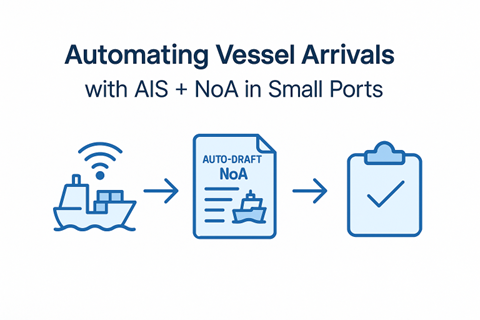
AIS (Automatic Identification System) transmits vessel identity, position, and course. SeaTech uses AIS during arrival and departure:
AIS Arrival Event:
- system records arrival timestamp,
- creates Auto-Draft NoA if none exists,
- coordinator receives notification.
AIS Departure Event:
- departure logged automatically,
- NoA moves to “Notified about Departure”.
This eliminates the need for manual AIS tracking.
Why digital NoA workflows simplify operations
Shipping agents enter data directly:
- vessel data,
- ETA/ETD,
- cargo details,
- requested services.
The system enforces required fields and applies validation rules. NoAs pass through clear states: Private → Submitted → Confirmed → Verified → Completed.
Multi-entry NoAs support offshore vessels performing frequent calls.
Automating berth and quay assignment
The interactive quay calendar prevents berth conflicts. Coordinators see:
- all reservations,
- bollard ranges,
- vessel lengths,
- overlapping calls.
Automatic calculation of services and dues
SeaTech calculates:
- shipping dues,
- cargo dues,
- services,
- OPS consumption,
- environmental fees.
This accelerates invoicing and reduces disputes.
The role of IMO blacklist automation
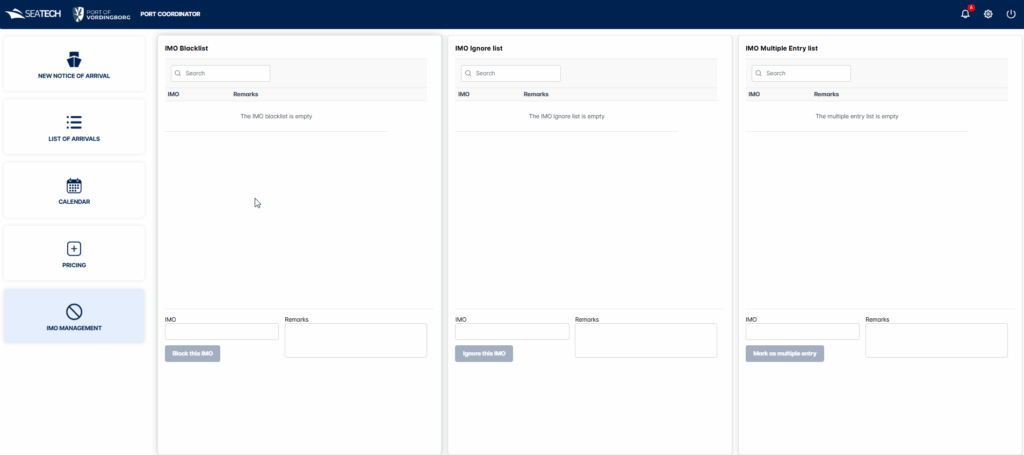
An automatically updated IMO blacklist blocks restricted vessels from creating NoAs, improving compliance and safety.
Offshore ports benefit the most
Offshore support vessels (CTV/SOV) generate frequent, short calls. AIS automation, multi-entry NoAs, and the quay calendar create a complete operational model for offshore wind support ports.
Summary
Key benefits:
- 70% less manual work,
- predictable vessel arrivals,
- real-time visibility,
- fewer errors,
- instant AIS-based verification,
- auditable digital records.