Summary
This article explains how SeaTech’s IMO Blacklist helps small and medium Baltic ports automate sanctions compliance. By combining AIS monitoring with port geofencing, the system detects restricted vessels in real time, flags them automatically, and alerts port coordinators before any services are provided. The feature reduces regulatory risk and embeds compliance directly into daily port operatio
In today’s regulatory landscape, sanctions compliance is no longer optional — even for small and medium-sized commercial ports.
For Baltic port operators in particular, the geopolitical environment and evolving EU sanctions framework create an additional layer of operational risk. A single sanctioned vessel entering a port area can expose the operator to serious legal, financial, and reputational consequences.
That is why SeaTech by Port Mapper includes a dedicated feature: IMO Blacklist — a real-time sanctions monitoring mechanism built directly into port operations.
Why Sanctions Monitoring Matters for Small and Medium Ports
Large international ports often rely on dedicated compliance departments and external risk intelligence providers. Smaller commercial ports typically do not have that luxury.
Yet the regulatory exposure is the same.
Under EU sanctions regulations, port operators may be prohibited from providing services to vessels owned, operated, or linked to sanctioned entities. The challenge is not only identifying such vessels — but doing so before services are rendered.
Traditional manual verification methods are:
-
slow,
-
error-prone,
-
dependent on human vigilance,
-
and difficult to scale.
In previous post we showed how port call operations can be optimized. This time, we introduce new functionaly – SeaTech’s IMO Blacklist which addresses another gap by embedding compliance logic directly into the operational layer of port management.
What Is the IMO Blacklist in SeaTech?
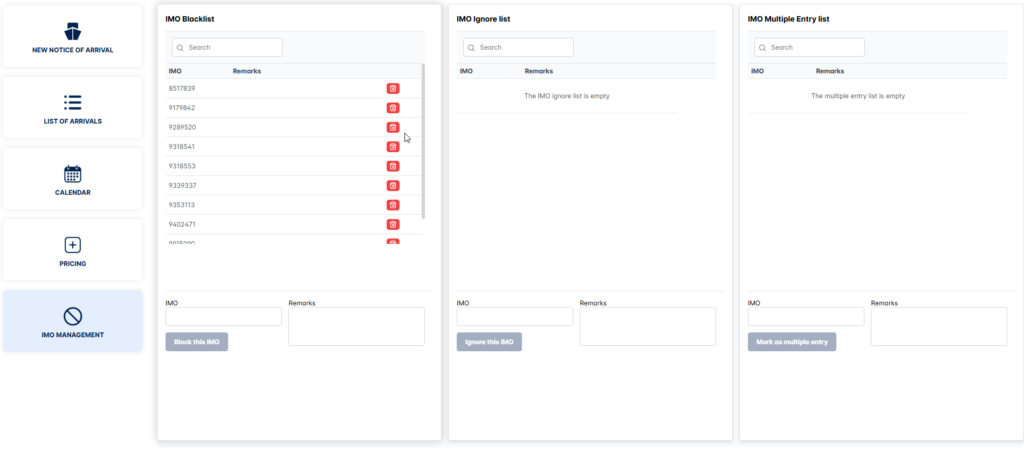
The IMO Blacklist is a configurable module within SeaTech that allows port administrators to define a list of vessel IMO numbers that should not be serviced by the port.
The blacklist can include vessels that:
-
are subject to EU sanctions,
-
are restricted under internal port policies,
-
are associated with prior incidents,
-
or are otherwise deemed non-serviceable.
Flexible Data Input
Ports can maintain the blacklist in several ways:
-
Manual entry of IMO numbers
-
Semi-automatic import from CSV files
-
Import from official EU sanctions publications (including structured data extracted from official documents)
This flexibility allows each port to align the process with its internal compliance workflow.
Real-Time Detection via AIS and Geofencing
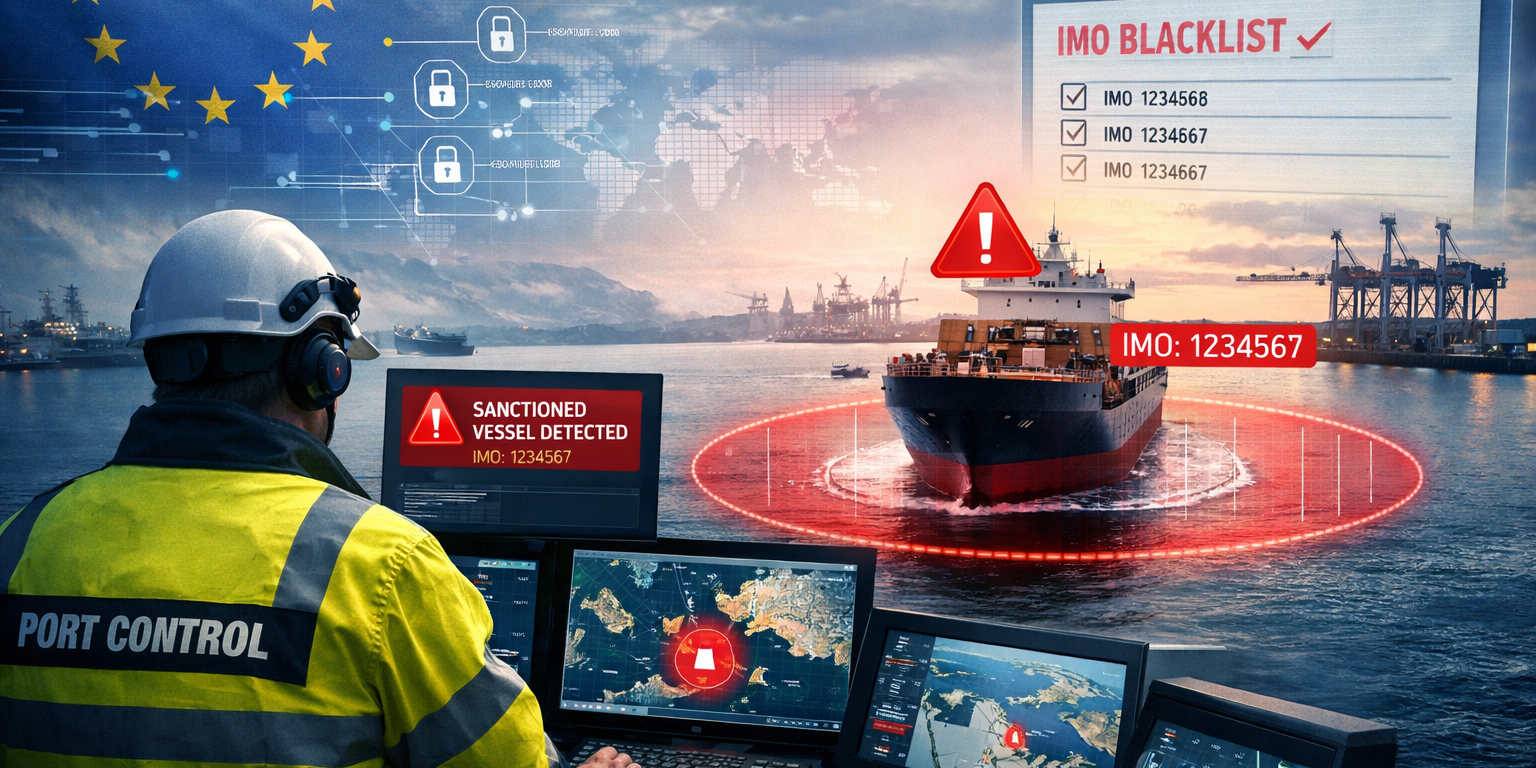
What makes the feature operationally powerful is not the list itself — but the automation layer behind it.
SeaTech continuously monitors AIS data in real time.
When a vessel enters the geofenced operational zone of a port administered by SeaTech:
- The system automatically checks the vessel’s IMO number against the configured blacklist.
- If a match is detected:
-
-
The vessel is assigned a special status within the system.
-
The port coordinator receives an immediate notification.
-
The vessel is excluded from standard service workflows.
-
Unlike regular vessels, a blacklisted unit is clearly flagged and not processed under normal operational procedures.
This removes ambiguity and reduces reliance on manual checks.
Operational Impact: Risk Reduction by Design
For small and medium Baltic ports, the IMO Blacklist provides:
Regulatory Risk Mitigation
Automatic detection reduces the likelihood of inadvertently servicing sanctioned vessels.
Auditability
All blacklist entries and detection events are logged within the system, creating a traceable compliance record.
Standardized Response
Instead of ad hoc decision-making, the system enforces predefined operational logic.
Early Awareness
Real-time AIS-based detection means port coordinators are informed at the moment of entry into the port zone — not after berthing or documentation processing.
Baltic Context: Why This Is Especially Relevant
Baltic Sea ports operate in a particularly sensitive geopolitical environment. EU sanctions frameworks evolve frequently, and enforcement scrutiny has increased.
Small and medium commercial ports often:
-
Operate with lean administrative teams
-
Manage both cargo and specialized maritime traffic
-
Lack dedicated compliance IT systems
SeaTech’s IMO Blacklist integrates sanctions awareness directly into daily port coordination activities — without requiring additional standalone compliance software.
It is not an external monitoring tool layered on top of operations.
It is part of the operational core.
Beyond Sanctions: Internal Policy Enforcement
While designed primarily for sanctions compliance, the IMO Blacklist also supports:
-
Ports that choose not to service specific vessel types
-
Operators enforcing internal environmental standards
-
Risk-based restrictions based on historical incidents
-
Insurance or contractual limitations
This transforms the module from a sanctions-only feature into a broader policy enforcement mechanism.
Compliance Embedded in Port Operations
In smaller ports, operational systems often evolve organically. Compliance processes are frequently manual add-ons.
SeaTech approaches the problem differently.
By integrating blacklist validation directly into:
-
AIS monitoring
-
Geofencing logic
-
Status management
-
Notification workflows
… the system ensures that compliance is not dependent on memory or manual verification.
It becomes a systematic safeguard.
Conclusion: Compliance as a Core Element of Modern Port Operations
For small and medium commercial ports in the Baltic region, digitalization is no longer only about improving efficiency. It is about building operational resilience in an increasingly complex regulatory environment.
SeaTech’s IMO Blacklist demonstrates how sanctions compliance can be embedded directly into daily port workflows — not treated as an external, manual control layer.
By combining:
-
automated sanctions list management,
-
AIS-based real-time vessel monitoring,
-
geofencing detection,
-
and system-enforced service restrictions,
SeaTech reduces regulatory exposure while maintaining operational clarity and auditability.
In a landscape where a single oversight can create legal and reputational consequences, automated vessel screening is no longer a feature reserved for major international hubs.
It is becoming a necessary component of responsible port governance.
Explore SeaTech
SeaTech is developed as an open and transparent solution.
If you would like to review the codebase, contribute, or deploy the system in your port environment, visit our GitHub repository:
👉 https://github.com/inero-software/seatech
If the project aligns with your goals, consider:
-
⭐ Starring the repository
-
🍴 Forking it for your own implementation
-
📥 Downloading and testing the platform
We welcome collaboration from port operators, developers, and maritime digitalization partners across the Baltic region and beyond.